
The Locke House
History and its Demolition

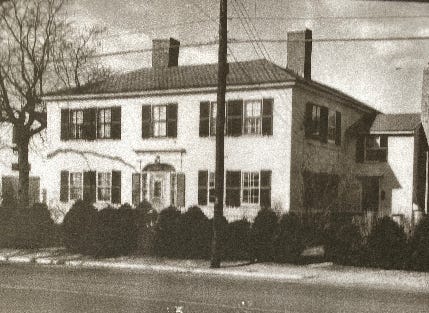
In October of 2024, I published a post here about the Locke House in New England. I’d first learned of the house in the 1853 book, Book of the Lockes, from which I drew a good deal of my research into my own connection to that family, in particular the Deacon William Locke, who apparently came to Massachusetts as an orphan.
I’d contacted the Woburn Historical Society in the summer of 2023, asking whether they knew anything about the Locke House, and they sent me the photograph pictured above, taken in the 1950’s. It’s generally been known as the Fox House, named for Captain William Fox, who’d eventually come to occupy it. The house, I was originally told, dated to the 1700’s—and this in a town that was named in 1642.
When I type the address “183 Lexington Street, Woburn, Massachusetts” into Google Maps, then switch into street view, what I see is a house that I was told no longer exists. “Whatever history my people left is long gone, save for the house,” I’d written last year. Now even that is gone.
The house was demolished in 2024. The house was built by, or at least for, my distant ancestor, the Deacon William Locke.
From the view on Google Maps, the house looks classically old. The white paint peeling, the shutters askew, some of the screens on the windows dislocated. The white fence pickets are comically rattled, slats missing or unhinged. At one point, what looks like a tree-of-heaven—an invasive—has broken through the fence. Tufts of overgrown grass burst out from under the fence and spray from a curb of cobbled stone.
To the side, you can see what appears to have been an attached barn and what look to be its original wooden doors. The maps suggest the property behind the house is largely wooded.
Once, a few years back, the house was for sale, and I’d gone to the Zillow site to see its interior. I regret not keeping those images through screenshots, something for my personal use. I remember its low ceilings, the iron oven in the brick wall. There were even photos of the interior of the barn.
I’d bought a plane ticket to Boston, so I could visit some sites in Connecticut for my genealogical research. I rented an apartment in Woburn for a night, both so I could rest after the flight and to swing by the house, maybe take some pictures. I reached out again to the Woburn Historical Society, and that’s how I found out I was too late.
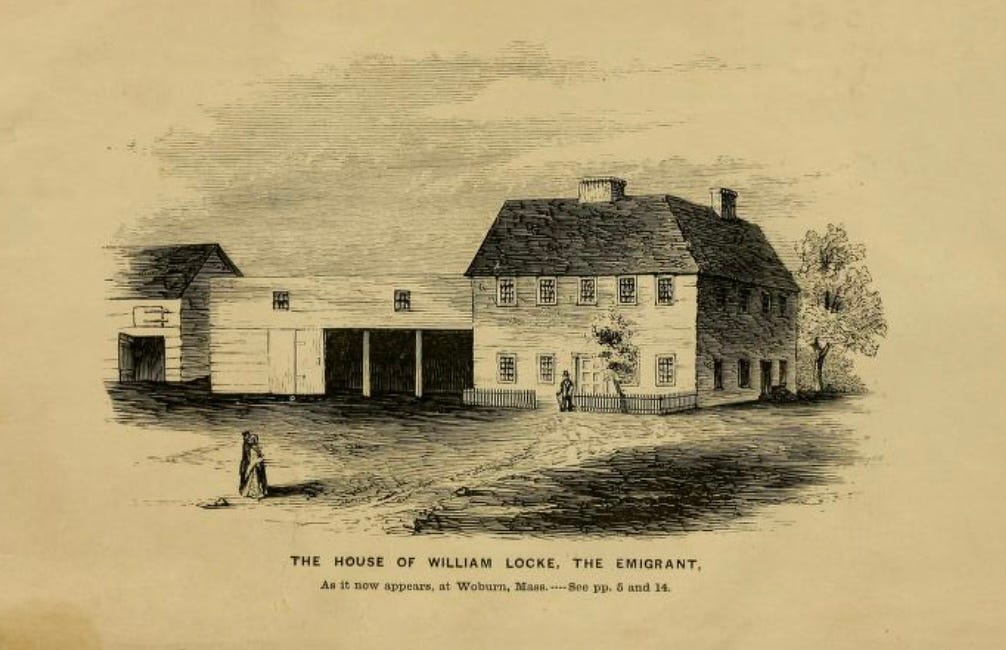
But then, I’m no longer sure that this house, in its entirety, is the original house. According to William Cutter’s Woburn Historic Sites and Old Houses, printed in 1892, only a “portion of the house occupied by William Locke is yet standing,” and previously, in 1853, John Locke, author of Book of the Lockes—in which appears an 1850 illustration of the house—says it was by then known as the Fox House.
William Locke, according to the author, purchased the property from one Goodman Pearson of Boston around 1650; he paid for it with clapboard bolts. William and John Johnson confirmed this sale in a deposition from October 13, 1671. According to the text, the house passed to William’s son Ebenezer in 1703, then to his son Samuel, who was said to have run an inn there before selling it in 1741 when he removed to Lancaster. The property, some 65 acres in all, was sold several more times until it was purchased by Thomas Fox, father of the captain William Fox, who had it at latest by 1798.
In late April, I’d reached out to the historical society, when Kathleen Lucero answered and forwarded me on to Darlene Wigton of the Woburn Historical Commission (she’s also on the historical society’s board of directors). Wigton told me that the petition to demolish the house came before the commission in September of 2020, and because the house was on the inventory of historically significant properties, it went to a public hearing in October, and a demolition delay was placed on it. By October of 2021, the delay expired.
She’d sent me documents about the house. On an inventory form of the Massachusetts Historical Commission it states the house was built in 1810, though this could indicate a number of things: that the older house was removed and a new one built, or that it was altered or remodeled from the original—the latter, according to the nineteenth century books I’d read, seemed to conform the latter. A history of the Fox family, published in 1899, says that William Fox “lived in the house of William Locke, the immigrant of 1635. This house was situated on Lexington street near the corner of Cambridge street, about a mile and a half westerly of Woburn Center.”
Ms. Wigton sent me the email of Bill Poole, and I wrote him. He told me that the Historical Society wanted to save the house but got little support from the community. “The home had a severe termite infestation,” he wrote, “and after spending a good deal of money, the owner decided to have it torn down.”
Two new homes were built on the site. “I have never had the heart to go back to the site and see what has been done,” Poole told me. He noted that, of course, he and I are cousins to some degree.
I’m looking at images of the house, the yard overgrown, one spray of the tree-of-heaven fallen onto the asphalt and wilted. There is a black pickup truck beside it, the license plate blurred out. The image capture was in August of 2023.
I think: had I never known this house exited, I’d have experienced no sense of loss. After all, all these ancestors besides the deacon, they all lived somewhere, pacing from room to room, sleeping, eating, sitting beside a fire. Whether a house or log cabin, many are gone.
I imagine myself walking through some of these houses, expecting to find…what?
In March, I wrote about the Tomb House in Slate Run, now a vacation rental. And nearly two years ago, wrote about the house of James Locke, one of the great-grandson of the Deacon William Locke, whose house still sits beside the highway just north of Millport, New York—empty, last I saw it. Finally, I think of the house I grew up in, at the edge of West Elmira, left in a state of disrepair.
I think about these ancestral houses while sitting in my own house, the roof intact, the hardwood floors holding up, everything for the most part functional. This is the house I’ve shared with my daughter for more than a decade now. What will happen when I leave?
What will happen to her memories when I’ve at last left the house?
Beautiful piece, Sean. We moved into our 1914-built home in 1991 when I was 8 months pregnant with our first daughter. We have the Realtor's photo (a print back then, glued to a sheet of colored printer paper) and a photo my mom took in front of the house just before she left on her first visit a month later. I'd be in labor a few hours later, delivering our first daughter.
Yeah, these photos become iconic.
Sean, have you tried looking for the Zillow page for that house in the Wayback Machine at the Internet Archive? You might get lucky; I see that thousands of pages have been archived at Zillow.com.
Ancestral homes have such a tug and you’ve written of it beautifully.
I’m in the process of building a family Century Safe - a time capsule - to be opened by my descendants in 2076.
My first ask was for photos of the houses we’ve lived in and the ones we remember.